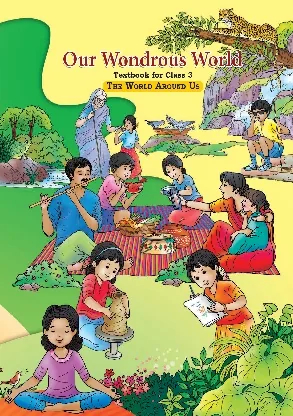
Class 3 · The World Around Us · New NCERT
Chapter 5: Plants and Animals Live Together
In this chapter
"Plants and Animals Live Together" explores how living things share the same places and depend on each other. Children observe a garden, pond, tree or field and notice who lives where, who eats what and how plants shelter and feed animals.
- Chapter
- 5 of 12
- Textbook
- Our Wondrous World
- Class
- Class 3 · The World Around Us
- Edition
- New NCERT
- Topics
- 4
Topics covered
- Plants and animals together
- Habitats
- Who eats what
- Interdependence
About this chapter
- The textbook's inquiry-based approach encourages observing, asking questions and drawing conclusions rather than memorising.
- The chapter builds early ideas about habitats and interdependence and encourages respect for all life.
- Outdoor observation, even of a single tree or a patch of ground, makes the lesson real and sparks curiosity.
How to study this chapter
After studying "Plants and Animals Live Together", take a short walk around the home or neighbourhood and ask your child what they notice.
- Encourage them to draw or describe what they see and to ask their own questions.
- Elders can add local stories, names and traditions that enrich the lesson.
Where this chapter fits
This is chapter 5 of 12 in Our Wondrous World, the Class 3 The World Around Us textbook, in Unit 2, Life Around Us, and begins on page 62 of the printed 2026-27 book.
- It follows "Getting to Know Plants" and is followed by "Living in Harmony".
More about this chapter
Curiosity is the starting point for "Plants and Animals Live Together".
- The book's presentation is child-friendly, with illustrations designed to build observation and critical thinking, and it uses dialogue, story or narrative to bring ideas to life.
- Activities are suggestions rather than requirements, so teachers can adapt them to the local setting.
- Children are assessed through what they do and say, such as sketches, labels, discussions and small investigations, rather than through recall alone.
Using this page
This overview is written from the 2026-27 textbook's Contents page, its preface and the chapter title, to help families and teachers prepare.
- Please read the chapter itself for exact content, activities and exercises.
- On this page you can download the Chapter 5 PDF and open the Chapter Solution page, which has the NCERT Archive solution PDF for this chapter.
- The "Topics covered" list on this page gives a quick checklist for revision: tick each one off once you can explain it in your own words, then attempt the chapter's questions before checking the solution.
- This chapter is part of Our Wondrous World, the New NCERT The World Around Us textbook for Class 3.
Download Chapter 5 in your language
This textbook is published in 23 languages. English is the default; pick any other language to download the same chapter in it.
- EnglishEnglishDefault
- हिन्दीHindi
- اردوUrdu
- অসমীয়াAssamese
- বাংলাBengali
- बड़ोBodo
- डोगरीDogri
- ગુજરાતીGujarati
- ಕನ್ನಡKannada
- كٲشُرKashmiri
- कोंकणीKonkani
- मैथिलीMaithili
- മലയാളംMalayalam
- মণিপুরীManipuri
- मराठीMarathi
- नेपालीNepali
- ଓଡ଼ିଆOdia
- ਪੰਜਾਬੀPunjabi
- संस्कृतम्Sanskrit
- ᱥᱟᱱᱛᱟᱲᱤSanthali
- سنڌيSindhi
- தமிழ்Tamil
- తెలుగుTelugu
No language matches that search.