NCERT Arts Book for Class 6 (New NCERT)
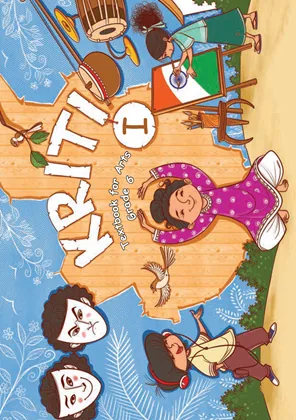
Textbook: Kriti
The NCERT Arts textbook (Kriti) for Class 6. All 22 chapters of the 2026-27 edition are listed below; full content, topic notes and downloadable PDFs are being added — check back soon.
- 22Chapters
- 22Languages
- NewNCERT edition
Available in 22 languages. English is the default — every chapter page has a download button for each language.
- English
- हिन्दीHindi
- অসমীয়াAssamese
- বাংলাBengali
- बड़ोBodo
- डोगरीDogri
- ગુજરાતીGujarati
- ಕನ್ನಡKannada
- كٲشُرKashmiri
- कोंकणीKonkani
- मैथिलीMaithili
- മലയാളംMalayalam
- মণিপুরীManipuri
- मराठीMarathi
- नेपालीNepali
- ଓଡ଼ିଆOdia
- ਪੰਜਾਬੀPunjabi
- संस्कृतम्Sanskrit
- ᱥᱟᱱᱛᱟᱲᱤSanthali
- سنڌيSindhi
- தமிழ்Tamil
- తెలుగుTelugu
Kriti I is the NCERT Arts textbook for Grade 6. Its preface describes it as a book that takes students into the world of visual and performing arts, aiming to ignite creativity, build appreciation of different art forms and develop artistic skills.
About this book
- It is based on the National Education Policy 2020 and the curricular goals, competencies and learning outcomes for Arts Education in the National Curriculum Framework for School Education 2023, and it offers many hands-on activities and projects.
- Students also learn about artists and their works, explore techniques and styles and create their own pieces.
- More activities and ideas are available through the QR code at the start of the book and in each chapter.
How to study this book
Families can help by supplying simple materials, appreciating the child's work without comparing it with others and attending local performances and exhibitions.
- The chapter list follows the Contents of the 2026-27 reprint; overviews describe themes from titles and the preface, so please check the lessons.
More about this book
The Contents page lists twenty-two numbered sections in four art forms.
- Visual Arts has five chapters, from "Objects and Still Life" to "Seals to Prints".
- Music has six, including "Music and your Emotions", "Musical Instruments", "Taal or Talam and Raga or Ragam in Indian Music", "Songwriting" and "Music and Society".
- Dance has four, including "My Body in Motion" and "Dances of Our Land".
- Theatre has five, from "Emotions Unveiled!" to "The Grand Finale", including a chapter on puppetry.
- Two closing sections follow: "Integration of All Art Forms" and "Assessment".
- The preface stresses aesthetic sensibility, the ability to perceive beauty, make considered judgements and strive for refinement, and says the core idea is that learners should enjoy the whole process of exploration without stress.
- It points to India's long heritage in which all art forms were practised.
Chapters
- Ch. 1Objects and Still Life
- Ch. 2Changing the Typical Picture
- Ch. 3Portraying People
- Ch. 4Paper Crafts
- Ch. 5Seals to Prints
- Ch. 6Music and your Emotions
- Ch. 7Musical Instruments
- Ch. 8Taal or Talam and Raga or Ragam in Indian Music
- Ch. 9Melodies of Diversity
- Ch. 10Songwriting
- Ch. 11Music and Society
- Ch. 12My Body in Motion
- Ch. 13Breaking Barriers with Dance
- Ch. 14Harmony in Motion
- Ch. 15Dances of Our Land
- Ch. 16Emotions Unveiled!
- Ch. 17Let's Design
- Ch. 18In the Company of Theatre
- Ch. 19Stories of Shadows and Strings — Puppetry
- Ch. 20The Grand Finale
- Ch. 21Integration of All Art Forms
- Ch. 22Assessment
About NCERT Arts for Class 6 (New NCERT)
What Arts covers
NCERT Arts covers visual arts, music, dance and theatre, encouraging students to create, perform and appreciate art from India's many traditions.
Why Class 6 matters
Class 6 begins the middle stage: Science and Social Science become separate subjects, and Mathematics introduces integers, algebra and geometry in a more formal way.
What's in this book (22 chapters)
Every chapter page has an overview, the chapter PDF and, where published, a step-by-step NCERT Solution. The first chapters are:
- Ch 1. Objects and Still Life
- Ch 2. Changing the Typical Picture
- Ch 3. Portraying People
- Ch 4. Paper Crafts
- Ch 5. Seals to Prints
- Ch 6. Music and your Emotions
How to study Arts
Try every activity, keep a sketchbook or practice log, and observe art in your surroundings.
Getting the most from NCERT Arts
1Arts is something you do
Bansuri in the preparatory classes, Kriti in the middle classes and Madhurima in Class 9 cover visual arts, music, dance and theatre. These books are not meant to be studied like a history book.
- Each chapter asks students to draw, sing, move, act, make and talk about what they have made.
- The learning happens in the doing — trying a folk painting style, learning a song, creating a short play with friends.
- The books also introduce India's huge variety of art traditions — regional painting styles, folk songs, classical and folk dances, puppetry and crafts.
- Reading about one tradition and then trying a small piece of it yourself is the best way to appreciate it.
- There is no single right answer in art, so encourage children to explain what they made and why.
2Making it part of everyday life
- Keep a sketchbook and draw something from daily life a few times a week.
- Listen to one piece of music from a different region of India every week.
- Visit local craftspeople, museums or performances when you can.
- Display children's work at home — it builds confidence and pride.
Frequently asked questions
How many chapters are there in Class 6 Arts (New NCERT)?
NCERT Archive lists 22 chapters for the New NCERT Arts book for Class 6 (Kriti).
Where can I download the Class 6 Arts New NCERT PDF?
Each chapter page has a Download Chapter PDF button, and the official NCERT site is linked from this page.
Are solutions available for Class 6 Arts (New NCERT)?
Yes — chapters with a published solution link to a step-by-step NCERT Solution page, and a solution PDF where one is available.
Related resources
More about this book
About this textbook
The NCERT Arts textbook for Class 6 is published here in its new ncert edition, as part of the middle stage of the NCERT curriculum, where subjects are taught in more depth and students start building the conceptual base that later classes rely on.
- NCERT — the National Council of Educational Research and Training — writes and publishes this textbook as the standard reference for Arts in CBSE and CBSE-affiliated schools across India, and it's what most school-level exams and homework for Class 6 are set against.
How this page is organised
This page is organised chapter by chapter, matching the structure of the printed textbook exactly, so a chapter number here always lines up with the same chapter number in the physical or PDF book.
- Each chapter links through to its full text and, where available, a step-by-step NCERT Solution written against the exercises in this specific edition.
New and old NCERT editions
Because NCERT periodically revises its textbooks, both a "New NCERT" and an "Old NCERT" edition can be in use at the same time in different schools.
- NCERT Archive keeps the two fully separate — this page covers only the new ncert edition of Arts for Class 6.
- If you're looking for the old edition instead, it's linked from this page (where published) so you don't end up mixing chapters, exercise numbers or solutions between the two.
How to study with this book
Reading the chapter first and attempting its exercises independently, before checking the matching NCERT Solution, tends to build a stronger and more exam-ready understanding of Arts than starting with the answers.
- Where NCERT has published an official PDF for this book, it's linked directly and marked "Official NCERT Source" so there's never any doubt about where it came from.