NCERT Urdu Book for Class 5 (New NCERT)
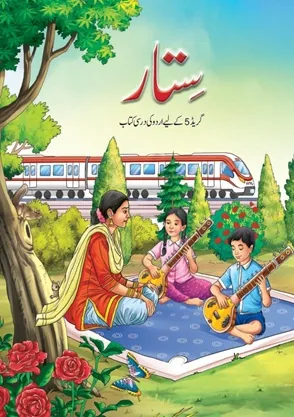
Textbook: Sitar
The NCERT Urdu textbook (Sitar) for Class 5. All 13 chapters of the 2026-27 edition are listed below; full content, topic notes and downloadable PDFs are being added — check back soon.
- 13Chapters
- NewNCERT edition
Sitar for Class 5 is the NCERT Urdu textbook for the last year of the Preparatory Stage. The Contents page of the 2026-27 reprint lists thirteen numbered chapters, labelled by form. They include poems by Ismail Meerathi ("Khuda Ki Qudrat"), Afsar Meerathi ("Rahnuma Ban Jaaun"), Allama Iqbal ("Shehad Ki Makkhi") and Hafeez Jalandhari ("Ganga"), folk and humorous tales such as "Talaab Ka Bhoot" and "Chacha Chhakkan Ki Ainak" by Imtiaz Ali Taj, a biography of Guru Nanak, a play adapted from the Panchatantra ("Chaar Dost"), a modern story ("Digital Dadi"), a letter ("Tulip Garden") and essays on kabaddi and on moving carefully.
More about this book
The mix of forms is deliberate: older and newer writers, verse and prose, a play and a letter, so that children meet the range of Urdu literature and practise reading different kinds of text.
- Themes, judging by the titles and forms, include nature, history and faith, sport, technology and care in daily life.
- A story by Madhu Malti Jain, "Chaar Sikke", and the closing essay "Chaliye Sambhal Sambhal Kar" round out the book.
- Five further pieces marked in the Contents without a chapter number are for reading and enjoyment: the essays "Taiyari Mein Hi Samajhdari Hai" and "Captain Haneefuddin", the story "Apni Hifazat Aap", a poem by Majaz Lucknowi and the picture story "Topi Wala Aur Bandar".
- They are not listed here as chapters.
- Because Urdu is cursive and written right to left, children benefit from regular reading aloud, copying neat lines and learning poems by heart.
- Families can help by listening, asking what a poem or story is about and sharing couplets and stories from their own heritage.
- Titles are shown in Urdu script.
- Overviews describe forms and likely themes from the Contents page, so please check each lesson for details.
Chapters
- Ch. 1خدا کی قدرت
- Ch. 2تالاب کا بھوت
- Ch. 3گرو نانک
- Ch. 4راہ نما بن جاؤں
- Ch. 5چچا چھکن کی عینک
- Ch. 6کبڈی
- Ch. 7شہد کی مکھی
- Ch. 8چار دوست
- Ch. 9ڈیجیٹل دادی
- Ch. 10گنگا
- Ch. 11ٹیولپ گارڈن
- Ch. 12چار سکّے
- Ch. 13چلیے سنبھل سنبھل کر
About NCERT Urdu for Class 5 (New NCERT)
What Urdu covers
NCERT Urdu (اردو) textbooks introduce Urdu prose and poetry — stories, nazms, ghazals and essays by well-known writers — with exercises in reading, vocabulary, grammar and writing.
Why Class 5 matters
Class 5 completes the primary stage, preparing children for the subject-based learning of the middle school with decimals, area, maps and richer stories and poems.
What's in this book (13 chapters)
Every chapter page has an overview, the chapter PDF and, where published, a step-by-step NCERT Solution. The first chapters are:
- Ch 1. خدا کی قدرت
- Ch 2. تالاب کا بھوت
- Ch 3. گرو نانک
- Ch 4. راہ نما بن جاؤں
- Ch 5. چچا چھکن کی عینک
- Ch 6. کبڈی
How to study Urdu
Read each lesson aloud, note new words with their meanings, and practise writing answers in clear Urdu script.
How to study NCERT Urdu
1Reading, writing and enjoying the language
The Urdu textbooks introduce the language through poems, stories, letters and essays drawn from a rich literary tradition. Read each lesson aloud first to get used to pronunciation and rhythm — especially ghazals and nazms, where the sound is part of the meaning.
- Then read it again for understanding, noting new words and their meanings in a small notebook.
- Neat handwriting matters in Urdu. Practise writing a few lines every day, paying attention to the joining of letters and the placement of dots.
- Learn the main grammatical terms the textbook uses and practise them with your own sentences.
- For literature questions, know the writer or poet, the central idea of each lesson and a couple of lines you can quote.
Frequently asked questions
How many chapters are there in Class 5 Urdu (New NCERT)?
NCERT Archive lists 13 chapters for the New NCERT Urdu book for Class 5 (Sitar).
Where can I download the Class 5 Urdu New NCERT PDF?
Each chapter page has a Download Chapter PDF button, and the official NCERT site is linked from this page.
Are solutions available for Class 5 Urdu (New NCERT)?
Yes — chapters with a published solution link to a step-by-step NCERT Solution page, and a solution PDF where one is available.
Related resources
More about this book
About this textbook
The NCERT Urdu textbook for Class 5 is published here in its new ncert edition, as part of the primary stage of the NCERT curriculum, where the focus is on building strong reading, number and observation skills through simple language and activity-based exercises.
- NCERT — the National Council of Educational Research and Training — writes and publishes this textbook as the standard reference for Urdu in CBSE and CBSE-affiliated schools across India, and it's what most school-level exams and homework for Class 5 are set against.
How this page is organised
This page is organised chapter by chapter, matching the structure of the printed textbook exactly, so a chapter number here always lines up with the same chapter number in the physical or PDF book.
- Each chapter links through to its full text and, where available, a step-by-step NCERT Solution written against the exercises in this specific edition.
New and old NCERT editions
Because NCERT periodically revises its textbooks, both a "New NCERT" and an "Old NCERT" edition can be in use at the same time in different schools.
- NCERT Archive keeps the two fully separate — this page covers only the new ncert edition of Urdu for Class 5.
- If you're looking for the old edition instead, it's linked from this page (where published) so you don't end up mixing chapters, exercise numbers or solutions between the two.
How to study with this book
Reading the chapter first and attempting its exercises independently, before checking the matching NCERT Solution, tends to build a stronger and more exam-ready understanding of Urdu than starting with the answers.
- Where NCERT has published an official PDF for this book, it's linked directly and marked "Official NCERT Source" so there's never any doubt about where it came from.