NCERT Urdu Book for Class 3 (New NCERT)
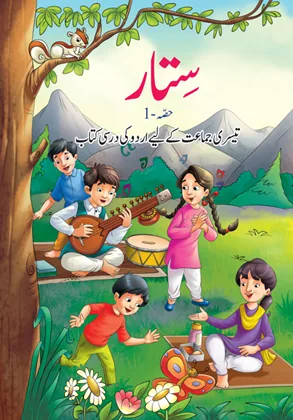
Textbook: Sitar
The NCERT Urdu textbook (Sitar) for Class 3. All 19 chapters of the 2026-27 edition are listed below; full content, topic notes and downloadable PDFs are being added — check back soon.
- 19Chapters
- NewNCERT edition
Sitar (Part I) is the NCERT Urdu textbook for Class 3, prepared for children who study Urdu as their mother tongue or home language. Its foreword links it to the National Education Policy 2020 and the National Curriculum Framework for School Education 2023, and says the book aims to develop conceptual understanding, critical thinking and creativity while fostering values such as inclusion, multilingualism, gender equality and cultural belonging. The prelims say it keeps in mind both the child's age and the child's interests.
More about this book
The Contents page of the 2026-27 reprint lists nineteen items in five units: Khandaan (family), Qaumi Yak-Jehti (national integration), Hamara Mahaul (our environment), Hamari Tehzeeb (our culture) and Sehat aur Ghiza (health and food).
- The prelims describe fifteen lessons in these units, plus four extra items for reading only: "Phool Kumari" (a story translated from Hindi), the poem "Sab ka Pyaara", the poem "Raat" and a picture story, "Lomdi aur Kauwa".
- All nineteen are listed here as chapters to match the printed contents.
- The mix of forms is wide: poems such as a hamd by Hafeez Jalandhari, Allama Iqbal's "Hamdardi" and Ismail Meerathi's "Barsaat", stories on friendship and kindness, essays on Eid, the world beyond the stars, a museum visit, football and nutrition, and a travelogue on Kashmir by Saliha Abid Hussain.
- The book also links Urdu with art, environment, science and social science to make learning connected.
- Life skills such as communication, cooperation and handling success and failure are woven in.
- Notes to teachers recommend reading aloud first, then letting children repeat, discuss meaning, and answer both oral and written questions.
- At home, ask the child to read a few lines, explain unfamiliar words, and talk about what they liked.
- Titles appear in Urdu script, and chapter overviews describe themes; check specifics against the lesson.
Chapters
- Ch. 1حمد
- Ch. 2آم کی گٹھلی
- Ch. 3عید
- Ch. 4بھارت پیارا، بھارت پیارا
- Ch. 5ستاروں سے آگے
- Ch. 6کشمیر
- Ch. 7برسات
- Ch. 8دوست کی پہچان
- Ch. 9میوزیم کی سیر
- Ch. 10ہمدردی
- Ch. 11بھلائی
- Ch. 12فٹ بال
- Ch. 13درختوں سے محبت
- Ch. 14نیم کا پیڑ
- Ch. 15تندرستی اور غذا
- Ch. 16پھول کماری
- Ch. 17سب کا پیارا
- Ch. 18رات
- Ch. 19لومڑی اور کوّا
About NCERT Urdu for Class 3 (New NCERT)
What Urdu covers
NCERT Urdu (اردو) textbooks introduce Urdu prose and poetry — stories, nazms, ghazals and essays by well-known writers — with exercises in reading, vocabulary, grammar and writing.
Why Class 3 matters
Class 3 introduces Environmental Studies alongside languages and Mathematics, and children begin reading independently and working with three-digit numbers.
What's in this book (19 chapters)
Every chapter page has an overview, the chapter PDF and, where published, a step-by-step NCERT Solution. The first chapters are:
- Ch 1. حمد
- Ch 2. آم کی گٹھلی
- Ch 3. عید
- Ch 4. بھارت پیارا، بھارت پیارا
- Ch 5. ستاروں سے آگے
- Ch 6. کشمیر
How to study Urdu
Read each lesson aloud, note new words with their meanings, and practise writing answers in clear Urdu script.
How to study NCERT Urdu
1Reading, writing and enjoying the language
The Urdu textbooks introduce the language through poems, stories, letters and essays drawn from a rich literary tradition. Read each lesson aloud first to get used to pronunciation and rhythm — especially ghazals and nazms, where the sound is part of the meaning.
- Then read it again for understanding, noting new words and their meanings in a small notebook.
- Neat handwriting matters in Urdu. Practise writing a few lines every day, paying attention to the joining of letters and the placement of dots.
- Learn the main grammatical terms the textbook uses and practise them with your own sentences.
- For literature questions, know the writer or poet, the central idea of each lesson and a couple of lines you can quote.
Frequently asked questions
How many chapters are there in Class 3 Urdu (New NCERT)?
NCERT Archive lists 19 chapters for the New NCERT Urdu book for Class 3 (Sitar).
Where can I download the Class 3 Urdu New NCERT PDF?
Each chapter page has a Download Chapter PDF button, and the official NCERT site is linked from this page.
Are solutions available for Class 3 Urdu (New NCERT)?
Yes — chapters with a published solution link to a step-by-step NCERT Solution page, and a solution PDF where one is available.
Related resources
More about this book
About this textbook
The NCERT Urdu textbook for Class 3 is published here in its new ncert edition, as part of the primary stage of the NCERT curriculum, where the focus is on building strong reading, number and observation skills through simple language and activity-based exercises.
- NCERT — the National Council of Educational Research and Training — writes and publishes this textbook as the standard reference for Urdu in CBSE and CBSE-affiliated schools across India, and it's what most school-level exams and homework for Class 3 are set against.
How this page is organised
This page is organised chapter by chapter, matching the structure of the printed textbook exactly, so a chapter number here always lines up with the same chapter number in the physical or PDF book.
- Each chapter links through to its full text and, where available, a step-by-step NCERT Solution written against the exercises in this specific edition.
New and old NCERT editions
Because NCERT periodically revises its textbooks, both a "New NCERT" and an "Old NCERT" edition can be in use at the same time in different schools.
- NCERT Archive keeps the two fully separate — this page covers only the new ncert edition of Urdu for Class 3.
- If you're looking for the old edition instead, it's linked from this page (where published) so you don't end up mixing chapters, exercise numbers or solutions between the two.
How to study with this book
Reading the chapter first and attempting its exercises independently, before checking the matching NCERT Solution, tends to build a stronger and more exam-ready understanding of Urdu than starting with the answers.
- Where NCERT has published an official PDF for this book, it's linked directly and marked "Official NCERT Source" so there's never any doubt about where it came from.